
Five Things to Know About the St. Johns River’s Gentle Giant: The West Indian Manatee
5 Fascinating Facts, Boating Safety Rules, Hotline Information, and Seasonal Sighting Tips
One of Florida’s most fascinating aquatic animals can be found in the St. Johns River and its connected waterways. The West Indian Manatee is the official name, but you may also hear them referred to as “sea cows.” According to History.com, one of the nation’s most famous explorers called them mermaids.

An excerpt on their website states:
“On January 9, 1493, explorer Christopher Columbus, sailing near what is now the Dominican Republic, records in his ship's journal that, on the previous day, he saw three ‘mermaids’—in reality manatees—and describes them as ‘not half as beautiful as they are painted.’”
Though you may hear different people call them manatees, sea cows, or even mermaids, there’s one thing that everyone can agree on – they are really amazing creatures. The St. Johns River and its connected waterways provide important habitat for manatees throughout much of the year, making them one of the area’s most beloved wildlife sightings. Here are a few things to know about these docile aquatic creatures.
- They may be big, but they’re not fat.
Yes, manatees may look like giant, fatty blobs floating in the river, and part of that is correct. These creatures are massive and can weigh up to 1,200 pounds. Don’t call them fat, though. They have a large gastrointestinal tract that can make up about 20% of their body mass, but actually don’t have much body fat. West Indian Manatees are herbivores and feed on an array of aquatic plants. Although they live off of nothing but greens, they are consuming a lot – a whole lot. They can eat up to nine percent of their body weight each day.

- Manatees move to warmer water when it gets cold.
Here in Florida, you’ll see manatees moving around when the temperatures start dropping. That’s because they can’t tolerate water that is less than 68 degrees Fahrenheit. If they’re exposed to chilly water for too long, they can develop cold stress, and it can be fatal. Once water temperatures start dipping, they set forth on a journey that takes them to nearby springs that are accessible from the St. Johns River. Those serve as their winter homes since the natural springs average a constant temperature of 72 degrees Fahrenheit.
- Manatees communicate with each other.
Just like us humans, manatees have a way of talking to each other, too. They have a variety of sounds that they make in different situations. Save the Manatee Club, a 501(c)(3) nonprofit organization that helps protect these gentle giants and their habitats, has put together some cool audio clips that allow you to hear manatees communicating with each other.
- Spring and summer are the best times to see newborn calves.
It’s such a treat to get to see a sweet little manatee. Although it’s possible to see a calf at any time in the St. Johns River, many are born in spring or summer. You’ll almost always see it with its mother, as a calf will stay with her for at least a year. While a newborn manatee is small in comparison to its mother, it can weigh more than 60 pounds when it is born.
- You can help manatees in need.
Most of the time, when you see manatees in the St. Johns River, they will happily be enjoying their time there. Whenever you see one, you can fill out a form to document your sighting. This serves as valuable information to researchers who are studying manatees and tracking their movement.
However, if you see one with fresh wounds, entangled in fishing line, or floating high in the water and not swimming down, you should report the situation to state wildlife officials instead. If you see a calf by itself without its mother, please reach out to them as well. If possible, snap a picture or take a video of the manatee in distress without getting too close – you don’t want to disturb it. While photos and videos can be beneficial to rescue crews, you don’t want to risk the manatee’s safety.
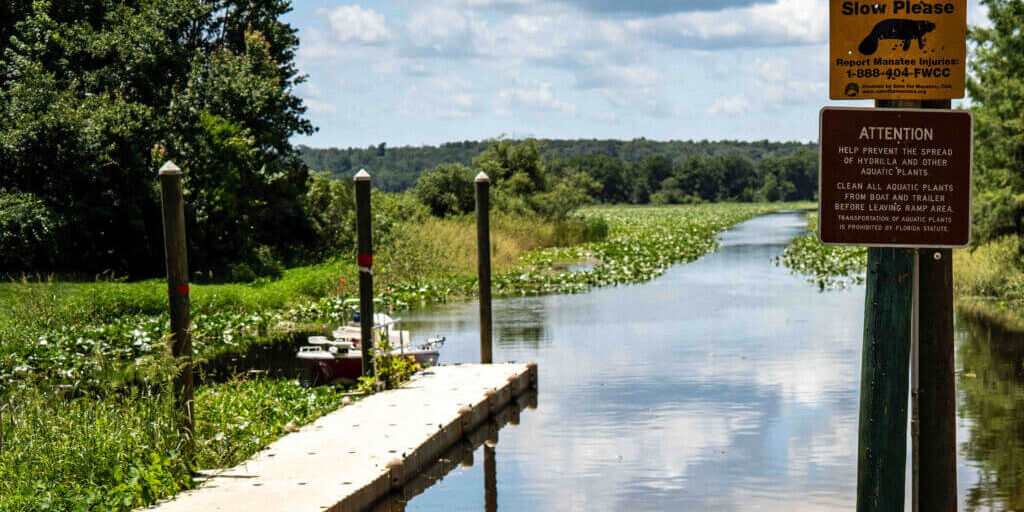
Florida Fish and Wildlife Conservation Commission: 1-888-404-3922

Three Tips for Safely Sharing the Waterways with Manatees in the St. Johns River:
- Watch your speed while boating.
Always pay attention to posted speed limits and stay in deep water channels while boating. Even in the deeper waters, though, you can still find manatees. Always be aware of your surroundings. If you see one while you’re boating, stay at least 50 feet away. If you plan to sit and watch the manatee, turn off your motor.
- Don’t touch manatees if you see one while paddling.
Putnam County is known as the “Trail Hub” of northeast Florida, and that includes many paddling trails. If you set forth on the local waterways on a canoe, kayak, or paddleboard, you may find yourself in shallower waters that are attractive feeding areas for manatees. If you happen to see one, it’s entirely possible that these curious creatures may come up to your vessel. It’s important that you refrain from touching them, though, as that is considered a form of harassment.
- Properly dispose of fishing line.
The St. Johns River and its connected waterways offer some of the best fishing spots in Florida. We encourage you to cast a line and enjoy the phenomenal fishing this area has become known for. Just make sure you keep all litter out of the waterways, including fishing line and hooks. Those can be hazardous to manatees if they become entangled in them, but luckily you’ll find plenty of places to recycle your fishing line in Putnam County.
Manatees are big fans of the St. Johns River and the waterways connected to it, and we think you will be, too. Spotting local wildlife is one of our favorite ways to enjoy a day on the water, but if you’re looking for more to see and do while you’re here, be sure to download the Visit Putnam FL app for Apple or Android.